

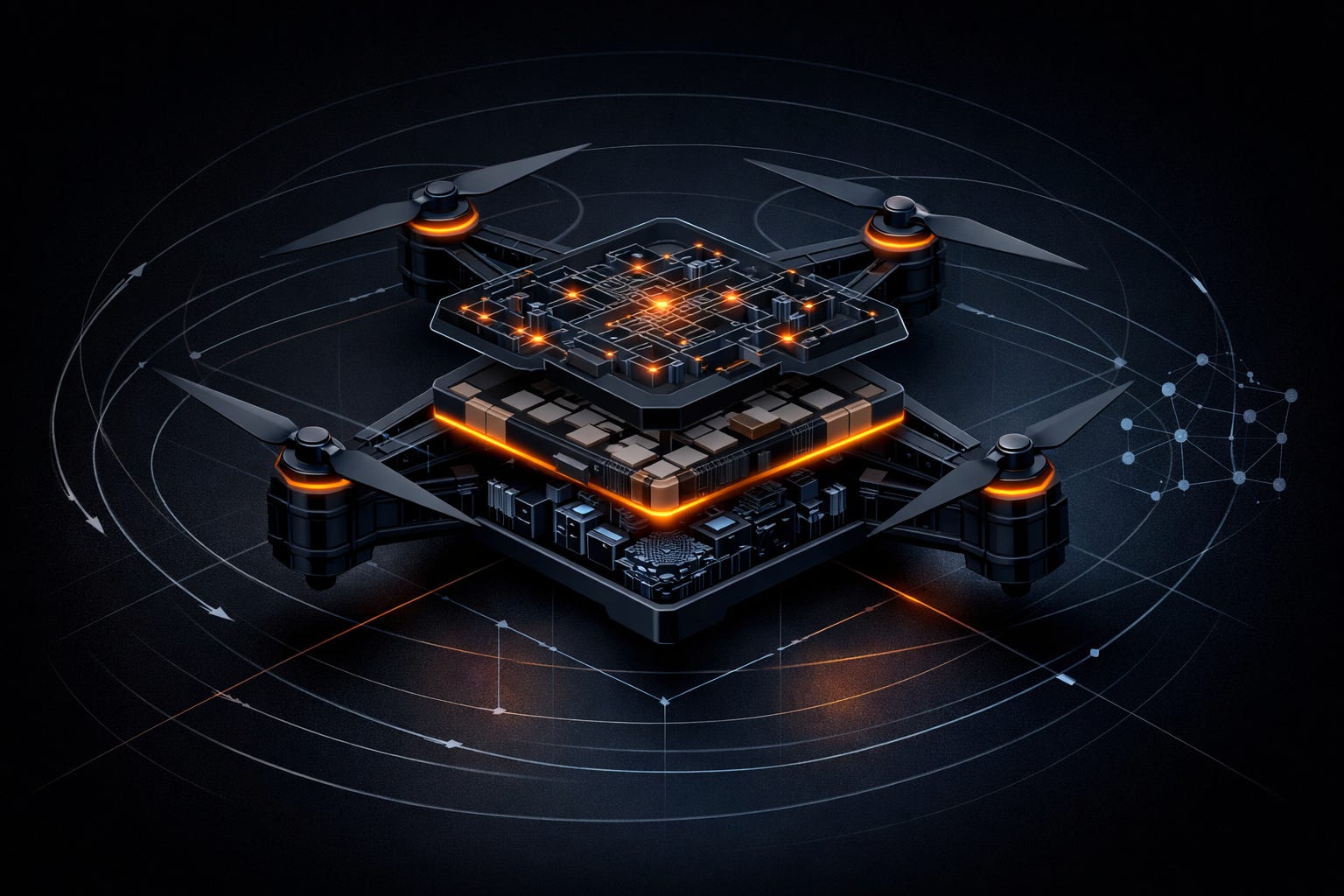
A drone is not a vehicle.
A vehicle carries passengers or cargo from one point to another. Its intelligence, if it has any, serves movement. A drone carries something harder to describe: the capacity to perceive, decide, and act, autonomously, under physical constraints, in real time. That capacity is not bolted on. It is the architecture.
Most discussions of drone swarms skip this entirely. They begin with the collective: formation logic, task allocation, communication protocols, and treat the individual drone as a black box with rotors. That abstraction collapses the moment you need the swarm to do anything real. A swarm is composed from individual units. If the individual unit’s architecture is wrong, no coordination layer recovers it. The drone brain is not a prerequisite to be hand-waved past on the way to the interesting parts. It is the foundation the entire system rests on.
This article establishes what a single drone is: a mechatronic intelligence built from three processing domains — electronic, mechanic, and software — integrated under constraints that cannot be negotiated. It introduces the three-brain architecture that separates what must never fail from what must continuously learn, and it shows why that separation is not a design preference but a survival requirement.
Three domains, one envelope
A drone is three interdependent systems sharing one physical envelope.
