


AWS has invested $1 billion in Forward Deployed Engineering and extended the model to strategic consulting partners through the Partner-Led FDE Motion (AWS’s program for building ring-fenced, AWS-credentialed engineering teams inside consulting firms). The mandate: embed engineering teams with customers, deploy production-grade agentic systems in weeks not months, and leave customers self-sufficient.
Partners building FDE practices face a structural challenge: how do you deliver at FDE velocity without rebuilding the methodology from scratch on every engagement? The answer is a delivery methodology that compounds. Each engagement refines investigation patterns, hardens specification formats, and expands the system-type library. The tenth engagement of the same system type starts in days, not weeks.
This article describes how the AI-Accelerated Modernization Framework serves as the production-grade delivery methodology for Partner-Led FDE modernization engagements.
The Problem FDE Solves for Modernization
Traditional modernization programs can run 12-18 months. Discovery takes weeks. Advisory produces recommendation decks that execution teams interpret differently. Specifications are informal. Execution tools are selected based on familiarity rather than fit. The result: programs that overrun budgets, hit scope surprises during execution, and produce systems that require remediation within months of go-live.
In practitioner experience, the cost difference between programs that invest in structured discovery and those that skip it can be substantial. In one example, the gap was $890K on a $2.5M program: the program that invested in discovery delivered with zero severity-one incidents, while the program that skipped investigation spent the savings several times over in rework and follow-on engagements. The specific numbers vary by engagement, but the pattern is consistent.
FDE compresses this timeline by replacing advisory decks with production systems, replacing informal specifications with structured artifacts and specs that AI coding tools consume, and replacing tool-specific expertise with a design layer that survives tool churn.
The Five-Phase Methodology
To solve these problems, we have developed the AI-Accelerated Modernization Framework gives FDE teams a repeatable five-phase lifecycle. Each phase has explicit entry and exit gates, defined deliverables, and clear accountability.
Phase 1: Setup creates the delivery scaffolding. Standards, templates, agent operating model, reference agents, governance. The FDE team agrees formats with the customer’s execution teams before any investigation agent runs. Exit gate: the delivery kit (Architecture Decision Records (ADR) templates, spec pack formats, quality gates, phase transition criteria) is committed and accepted.
Phase 2: Investigation designs purpose-built agents for the specific system landscape. A 2-5 day human-led assessment determines which system type pattern the target fits and which data sources are accessible for agent tooling. The agents run under the customer’s governance and produce structured findings. The investigation covers all four dimensions: code, data, integration, and infrastructure.
Phase 3: Advisory runs a structured interrogation loop. Agents present findings, the customer injects constraints, agents update, the customer interrogates, decisions lock as Architecture Decision Records. ADRs are binding execution constraints with conditions for revisiting.
Phase 4: Design-to-Spec translates ADRs into structured service specifications that AI coding tools can consume. The specification format is tailored to the customer’s chosen execution tool. A human architect validates every specification against the ADRs before code generation begins.
Phase 5: Execution implements using interchangeable tools (AWS Transform, Kiro, AWS Database Migration Service, AWS Application Migration Service, or others). Exit gates include Go/No-Go decision records, operational readiness evidence, and rollback procedures.
The Reusable Delivery Harness
The AWS Partner-Led FDE announcement describes building “a reusable delivery harness that the partner owns permanently.” The AI-Accelerated Modernization Framework’s Reusable IP Model is that harness, structured as three layers:
Layer 1: Methodology (reusable across all engagements). The five-phase lifecycle, the interrogation loop design, the ADR format, the spec pack templates, the agent operating model. This layer does not change between engagements; it improves.
Layer 2: System-type library (reusable within an archetype). The monolithic database investigation pattern transfers to any engagement with a monolithic database. The coupled enterprise application pattern transfers to any integration-sprawl environment. The IT/OT pattern transfers to any hybrid modernization. Each pattern includes: agent designs, output schemas, gold-standard examples, and lessons learned.
Layer 3: Per-engagement configuration (unique to each program). The specific database platform, integration substrates, vendor applications, OT protocols, non-functional requirements, and engagement-specific constraints. This layer is configured from Layer 1 and Layer 2, not built from scratch.
The compound learning effect: each engagement refines Layers 1 and 2. An FDE practice on its tenth OT/IT engagement configures investigation agents in days because the pattern has been validated across nine prior engagements and the edge cases are documented.
What Partners Accumulate
The AWS Partner-Led FDE blog describes partners building: domain ontologies, evaluation frameworks, MCP servers, agent operations tooling, and a context graph recording architecture choices. The framework maps these directly:
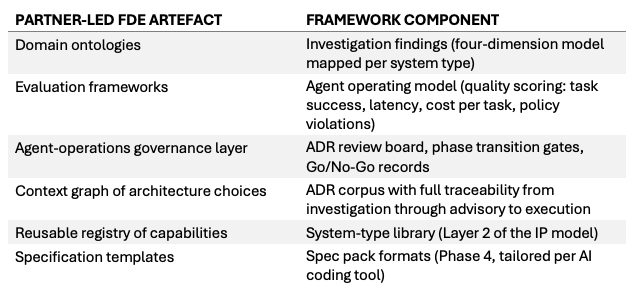
The delivery IP stays with the partner. The compounding advantage stays with the partner. The outcome it enables belongs to the customer.
Why This Methodology, Not Another
The framework was designed for the specific problem FDE modernization teams face: complex legacy systems where no single person can draw the complete map, where integration patterns are undocumented, where business logic has migrated into the data layer, and where the OT/IT boundary introduces infrastructure constraints that no amount of code analysis reveals.
Generic AI tools are too shallow for these systems: they see one dimension of a four-dimension composite. Proprietary migration platforms are too opinionated: their fixed workflows do not adapt to the variety of system types partners encounter across engagements. This framework fills the middle ground because it separates the methodology (repeatable across all engagements) from the system-specific configuration (adapted per engagement from the system-type library). The methodology stays constant. The configuration adapts. Both compound.
For partners evaluating whether to adopt this framework for their FDE practice, the competitive question is: how deep is your system-type library, and how quickly can you configure it for a new engagement?
Getting Started
For partners ready to adopt the framework for their FDE practice:
Explore the framework: The full AI-Accelerated Modernization Framework with evidence base and detailed component descriptions.
Download the whitepapers: Audience-specific versions for:
Join the Partner-Led FDE Motion: Contact your AWS Partner Development Manager to discuss how to build an AWS FDE practice using this methodology.
The accelerator is not the AI. The accelerator is the design of the AI agents.
About the Authors
Erik Farr is the global Director of Solution Architecture for Consulting Partners at Amazon Web Services, where he leads the Partner-Led FDE motion and is focused on growing and scaling consulting partners worldwide. He is the author of Cloud Native Architectures and Architecting Cloud Native Applications, both precursors to how the cloud has evolved to use AI and how FDEs will be deployed long into the future.
Aaron Sempf is APJ Next-Gen Tech Lead at Amazon Web Services, specializing in autonomous systems architecture, enterprise modernization, and AI agent design. He is the author of the AI-Accelerated Modernization Framework and the Architecting Autonomy series on constitutional governance for autonomous systems.